The gates of Evercare Hospital in Dhaka became a quiet place of mourning on Tuesday as word spread that Khaleda Zia, one of Bangladesh’s most influential political figures and a former prime minister three times over, had passed away. She had been undergoing treatment there since November 23, and as the news broke, supporters, party workers, and ordinary citizens gathered outside, many in tears, offering prayers in silence.
“We couldn’t stay at home after hearing this,” said BNP activist Riyadul Islam, standing among the crowd. “We may not be able to see her, but being here feels necessary. Everyone is heartbroken.”
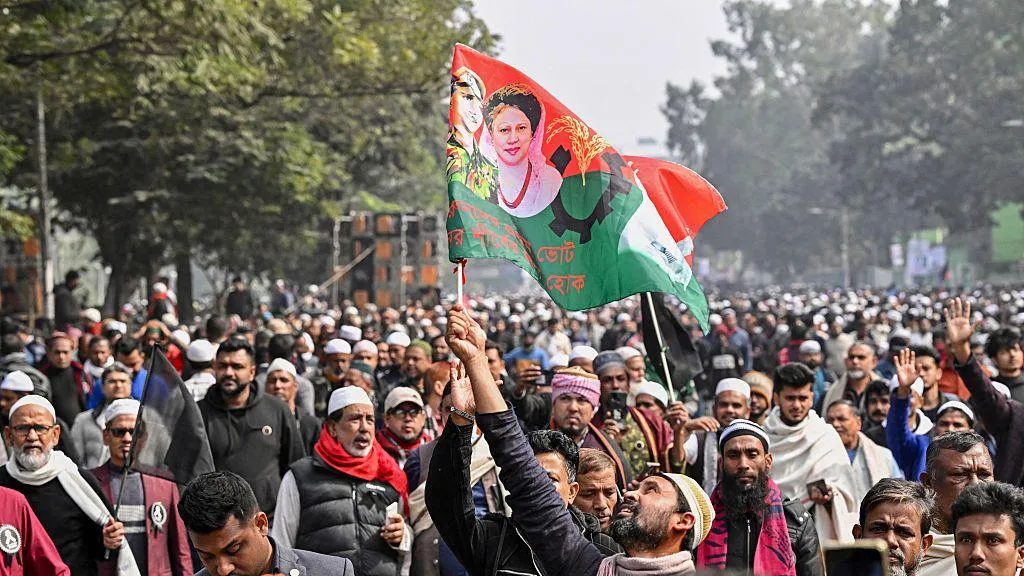
The following day, her funeral at Manik Mia Avenue drew tens of thousands of people. Leaders from different political parties, members of the interim government led by Muhammad Yunus, and foreign diplomats joined the massive crowd. The turnout showed just how deeply Khaleda Zia’s influence ran, not only within her party, the Bangladesh Nationalist Party (BNP), but across the country and beyond.
Her death, however, is more than a moment of national grief. It also marks a major turning point for the BNP at a sensitive time. With national elections set for February 12, the party now faces the campaign without the woman who had long been its unifying symbol, even during years when illness kept her away from active politics.
For decades, Khaleda Zia was more than just a leader in name. Even when she wasn’t visible on the political stage, she remained the party’s moral anchor, someone whose presence helped keep internal disputes in check. Now, with her gone, the BNP is fully entering a new chapter, one where leadership rests squarely on her son, Tarique Rahman, the party’s acting chairperson.
Mahdi Amin, an adviser to Tarique Rahman, described Khaleda as a “guardian” of the nation. He said her politics stood for democracy, the rule of law, and free expression, and that the BNP aims to carry those values forward if it returns to power. According to Amin, Tarique has already played a key role in shaping the party’s future, including helping lead the movement that ended Sheikh Hasina’s rule in July 2024 and outlining a reform plan focused on restoring voting rights and accountability.
Still, political analysts say Khaleda’s absence leaves a gap that won’t be easy to fill. Writer and analyst Mohiuddin Ahmed pointed out that her personal charisma helped keep the BNP united and energized. “That rhythm is gone now,” he said. “Tarique Rahman still has to prove himself. His leadership hasn’t truly been tested yet.”
Ahmed noted that Khaleda herself once stepped into politics under difficult circumstances, rising to prominence after her husband, President Ziaur Rahman, was assassinated in 1981. He believes the upcoming election could be a defining moment for Tarique as well success could cement his role, while failure could bring tough questions.
The political landscape itself has also changed. For years, Bangladeshi politics was dominated by the rivalry between the BNP and the Awami League. Now, with the Awami League banned from political activity, the field is more crowded. New alliances, including a strong bloc led by Jamaat-e-Islami and groups formed by youth leaders from the 2024 uprising, are reshaping the contest.
“This won’t be an easy race for the BNP,” Ahmed said. “The old two-party dominance no longer applies.”
There are also broader concerns: whether the election will happen on time, whether it will be peaceful, and whether voters will trust the process.
Political scientist Dilara Choudhury said Khaleda Zia acted as a stabilizing force not just for her party, but for the country as a whole. Her death, she said, leaves a void at a time when steady leadership is badly needed. Choudhury noted that Tarique Rahman’s return to Bangladesh on December 25, 2025, after years in exile, has eased fears of internal splits. His recent speeches, she said, have reassured supporters that the party’s core beliefs remain intact.
“Both the BNP and the Awami League have always revolved around strong personalities,” she said. “After Khaleda Zia, it’s natural for Tarique to step into that role.”
Still, challenges remain. Allegations of misconduct involving some party members continue to surface, and BNP leaders admit they will need stronger discipline at the grassroots level. Some local activists say disagreements are inevitable, but believe Tarique can manage them.
As the party looks ahead, many supporters see the future in deeply personal terms. At a rally in Dhaka, 57-year-old Dulal Mia recalled meeting Ziaur Rahman as a child, an experience that made him a lifelong BNP supporter. For him, the party’s story is tied to one family’s legacy.
“Tarique Rahman has to live up to his parents’ example,” he said. “If he doesn’t, people will turn away. But if he does, the people will stand with him just as they did with Ziaur Rahman and Khaleda Zia.”
As Bangladesh moves toward a critical election, the question now is whether the BNP can turn grief into momentum and whether Tarique Rahman can transform inheritance into leadership.